

Is Your Therapy Ready for Direct-to-Patient Model?
Pharmaceutical manufacturers have more options than ever for getting therapies to patients. But more choice doesn’t necessarily make the decision easier.
Direct-to-patient (DTP) models, digital pharmacies, traditional coverage pathways and more specialized access models can each play an important role in connecting patients with therapy. The challenge is determining which approach is right for a particular drug and patient population.
The answer shouldn’t begin with a channel. It should begin with the therapy.
At HealthDyne, we believe two factors can provide a useful starting point for evaluating the right patient access strategy:
- How much affordability pressure does the therapy face?
- How complex is the therapy and its patient journey?
Looking at these dimensions together creates a practical framework for understanding where different access models can deliver the most value and when a direct-to-patient strategy may make sense.
Why There Is No One-Size-Fits-All Patient Access Model
The path from prescription to therapy has become increasingly complex. Manufacturers must account for payer coverage, patient out-of-pocket costs, prior authorization, affordability programs, clinical support requirements, distribution needs, patient education, adherence and more.
At the same time, patient expectations are changing. Consumers increasingly expect healthcare experiences that offer greater convenience, transparency, digital communication and home delivery. These dynamics have accelerated interest in direct-to-patient models. But DTP isn’t automatically the right answer for every therapy.
A better question is: What barriers stand between this therapy and the patient, and which model is best equipped to remove them?
Two considerations can help answer that question.
The Two Dimensions of Patient Access Strategy
1. Affordability Pressure
Affordability pressure reflects the financial barriers that can prevent or delay a patient from starting or staying on therapy.
Questions to consider include:
- What will patients typically pay out of pocket?
- How significant is payer coverage to therapy access?
- Are patients likely to encounter high deductibles or other cost barriers?
- Are manufacturer-sponsored affordability programs an important part of the access strategy?
- Could greater pricing transparency influence prescription conversion?
- Is prescription abandonment due to cost a meaningful concern?
As affordability pressure increases, manufacturers may need greater flexibility and visibility to connect patients with an appropriate path to therapy.
2. Therapy Complexity
Therapy complexity reflects the clinical and operational requirements involved in getting a patient successfully started and maintained on treatment.
Considerations may include:
- Does the therapy require prior authorization or other access support?
- Is specialized patient education required?
- Does the therapy require clinical monitoring or pharmacist intervention?
- Are there unique handling, administration, or distribution requirements?
- How intensive is the patient onboarding process?
- What level of ongoing adherence support is necessary?
The greater the complexity, the more infrastructure and clinical support may be required around the therapy.
The Four Patient Access Models
When affordability pressure and therapy complexity are considered together, four distinct strategic approaches begin to emerge.
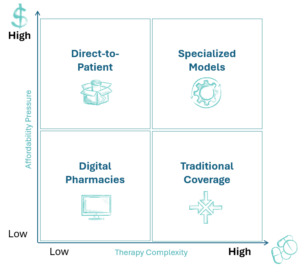
- Digital Pharmacy: Optimize convenience, engagement and fulfillment
- Traditional Coverage: Navigate payer requirements while supporting more complex therapy needs
- Direct-to-Patient: Create greater affordability choice and a more direct path to therapy
- Specialized Models: Combine affordability, access and higher-touch clinical support
The value of this framework isn’t in placing every therapy neatly into a box. Healthcare rarely works that way. Instead, it gives pharmaceutical manufacturers a way to begin the strategic conversation around the needs of the therapy and patient before selecting the infrastructure that will support them.
Digital Pharmacy: Lower Affordability Pressure + Lower Therapy Complexity
When both affordability pressure and therapy complexity are relatively low, the primary opportunity may be to improve the patient experience rather than fundamentally redesign the access pathway.
Digital pharmacy models can help create a more convenient and connected experience through capabilities such as digital onboarding, communication, prescription fulfillment, home delivery, refill support and ongoing engagement.
In this model, the strategic question may be less about overcoming major access barriers and more about: How can we make an already manageable therapy journey easier for the patient?
The goal is often convenience, engagement and a more seamless experience.
Direct-to-Patient: Higher Affordability Pressure + Lower Therapy Complexity
When therapy complexity is relatively low but affordability pressure is high, direct-to-patient models can become particularly compelling.
Importantly, a DTP strategy doesn’t have to mean choosing between insurance coverage and cash pay. A more flexible model can bring cash and covered access together within the same patient experience, allowing consumers to understand their options and choose the path that works best for them.
For example, one patient may find that accessing a therapy through their insurance provides the best value. Another may face a high deductible, coverage restriction or other barrier that makes a cash option more attractive.
Rather than forcing every patient down the same pathway, DTP can create greater choice and transparency at the point of access. That flexibility can create value on both sides of the equation.
For patients, it can mean:
- Greater visibility into access and affordability options
- More choice in how they obtain their therapy
- A simpler path from prescription to fulfillment
- Home delivery and digital engagement
- Fewer unnecessary points of friction
For manufacturers, integrating cash and covered pathways can create opportunities to expand access while taking a more strategic approach to gross-to-net economics, prescription conversion and visibility across the patient journey.
This is an important distinction. The value of DTP isn’t simply moving fulfillment closer to the consumer. It’s creating an access experience capable of finding a better path to therapy for each patient.
Traditional Coverage: Lower Affordability Pressure + Higher Therapy Complexity
When therapy complexity is high but affordability pressure is relatively manageable, payer coverage and established access pathways may continue to play a central role.
These therapies may require more sophisticated reimbursement navigation, clinical intervention, patient education or ongoing support.
In this model, the priority is often ensuring that the infrastructure surrounding the therapy can appropriately manage its clinical and operational requirements.
The key question becomes: What support does the patient need to successfully navigate a complex treatment journey?
Rather than redesigning the pathway primarily around affordability, manufacturers may benefit from optimizing the coordination, clinical support and access services surrounding existing coverage models.
Specialized Models: Higher Affordability Pressure + Higher Therapy Complexity
The greatest challenge occurs when a therapy faces significant pressure across both dimensions. Patients may encounter meaningful financial barriers while simultaneously navigating a complex clinical and access journey. In these situations, no single traditional model may address every need.
Manufacturers may need a more specialized strategy combining elements of affordability support, reimbursement navigation, clinical services, patient engagement, fulfillment and ongoing adherence support.
The objective isn’t to force the therapy into an existing model.
It’s to build a connected ecosystem around the barriers that matter most for that particular patient population.
Evaluating Your Therapy
The affordability-versus-complexity framework provides a useful starting point, but determining where a therapy sits requires looking beneath those two dimensions.
For pharmaceutical manufacturers evaluating whether a direct-to-patient strategy could be appropriate, three areas deserve particular attention the product, the patient journey and the financial dynamics surrounding access.
Product: What does the therapy require?
Start with the characteristics of the product itself. Consider:
- What level of clinical complexity does the therapy present?
- Are there unique storage, handling, administration, or distribution requirements?
- Does initiation require significant clinical education or monitoring?
- How frequently is the therapy dispensed or administered?
- What support is necessary for patients to use the therapy appropriately?
- Do the product’s characteristics create constraints around how it can reach the patient?
These factors establish the operational foundation for any access model. A strategy that works well for a relatively straightforward self-administered therapy may not be appropriate for a product requiring significant clinical intervention.
Patient Journey: Where does friction occur?
Next, look at the experience from the patient’s perspective. Consider:
- What happens after the prescription is written?
- Where are patients most likely to experience delays or abandonment?
- How difficult is it for patients to understand their coverage and out-of-pocket responsibility?
- Would patients benefit from seeing multiple affordability or access options?
- How important are convenience, home delivery, and digital engagement?
- What support is required to initiate therapy and remain adherent?
- Where could a more connected experience remove unnecessary steps?
This is often where the opportunity for DTP becomes clearest. The question isn’t simply whether the prescription can be fulfilled directly. It’s whether redesigning the journey can meaningfully reduce friction between prescription and therapy initiation.
Financial Dynamics: How do access decisions affect both patient affordability and brand economics?
Finally, manufacturers need to evaluate the economics surrounding the therapy. Consider:
- What level of affordability pressure do patients experience?
- How does patient out-of-pocket responsibility vary by coverage status?
- When might cash offer a viable alternative to the covered pathway?
- Could giving patients visibility into both cash and covered options improve access?
- How do current access pathways influence abandonment and conversion?
- What are the gross-to-net implications of different access strategies?
- Can a different model improve patient affordability while supporting sustainable brand economics?
This is where DTP can represent more than a fulfillment strategy. When manufacturers can orchestrate both cash and covered access within a connected experience, the conversation shifts from “Which payment model should we use?” to “How do we help each patient identify an appropriate path to therapy?”
That creates the potential for a more consumer-centered experience while giving manufacturers another lever to consider as part of their broader access and gross-to-net strategy.
The Big Question: Is Direct-to-Patient Right for Your Therapy?
Direct-to-patient is creating new possibilities for pharmaceutical manufacturers, but it isn’t the answer for every product. The opportunity is bigger than replacing one pharmacy channel with another. It’s about designing access around the realities of the product, the patient journey and the financial dynamics surrounding the therapy.
For therapies with relatively low complexity but significant affordability pressure, DTP may create an opportunity to bring cash and covered access together, give patients greater choice and transparency, reduce friction and create a more connected path from prescription to therapy.
For other therapies, a digital pharmacy experience, traditional coverage pathway or more specialized model may be a better fit. The important thing is to diagnose the access challenge before prescribing the solution.
HealthDyne developed the Direct-to-Patient Scorecard to help pharmaceutical manufacturers do exactly that. The complimentary assessment evaluates a therapy across multiple dimensions to help teams understand where their therapy sits and whether a direct-to-patient strategy warrants further exploration.
Where does your therapy fit? Take the assessment to find out.